
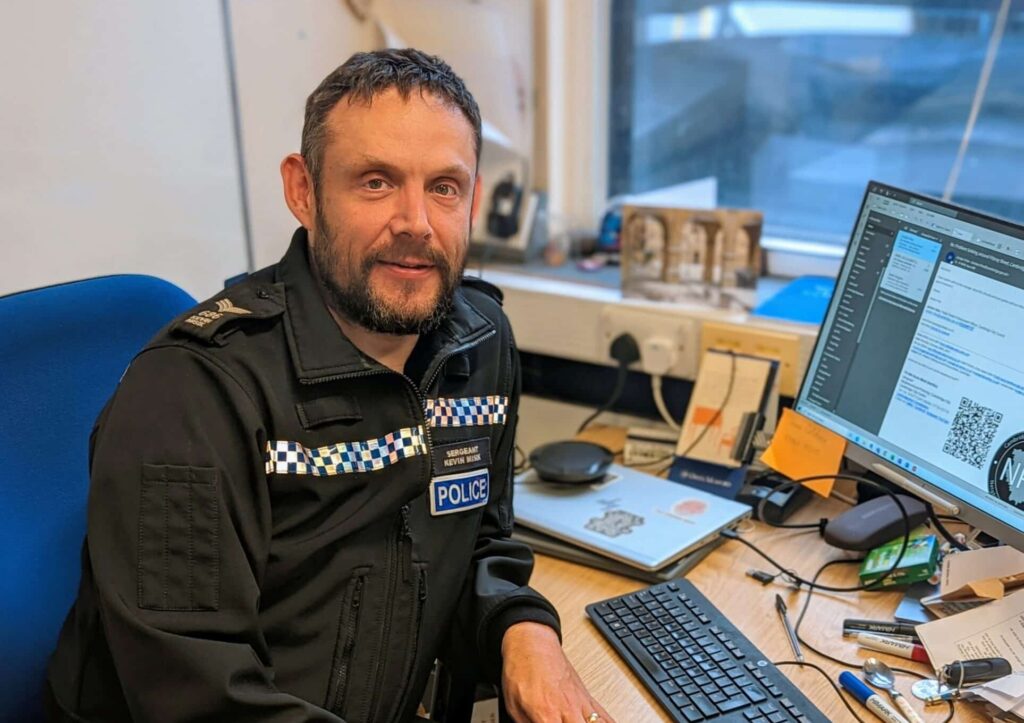
Cambridgeshire Police Federation secretary Sergeant Kevin Misik says his own career shows how far policing has come in supporting neurodivergent officers and staff.
Kevin, who has more than 26 years’ service with the Force, is dyslexic and has shared his experience for Neurodiversity Celebration Week (16 to 20 March).
He said that when he joined policing in 1999, it felt like the organisation had little understanding of neurodiversity.
“I didn’t fit into a box,” he said. “There were things I was good at and things I wasn’t very good at.
“But back then the organisation didn’t really know what to do with someone who was different.”
During his probation, tasks that involved a lot of writing were particularly difficult. Indeed, handwritten statements and files were a major part of the job at the time.
“I wrote a statement three times after an arrest and it kept going wrong,” he recalled. “I still remember the tears staining the paper because I just couldn’t get it right.”
His tutor officer delivered a blunt verdict.
“He said, ‘Kevin, you’ll never be a police officer. If you ever become one, you can call me a ****’,” Kevin said. “Years later, I ended up being his line manager. When he retired, I reminded him.”
During his probation, concerns about his performance led to Kevin being sent to London for a specialist assessment.
He said: “In hindsight, I think they wanted a report so they could sack me.”
Instead, the specialist recognised his abilities.
“She wrote that I was quite articulate, quite intelligent and thought I’d be good at the job,” he said.
He was moved to a quieter rural station and paired with a different tutor, a change that made a big difference, he said.
Kevin said that dyslexia still affects his work and personal life, from being easily distracted to struggling to remember names.
But neurodiversity is also a strength and brings with it different ideas and ways of approaching things, he said.
Policing was now far more aware of neurodiversity and the strengths it can bring, he said, adding that the culture within policing has changed significantly, with student officers now screened for dyslexia and offered support early in their careers.
“It’s not the same organisation as when I joined,” he said. “The approach then was basically to push you through the system harder.
“Now we recognise that people can do the job, but they might do it in a slightly different way.
“I think we value difference in a way now that we never did when I was young.
“Just because you’re not exactly the same as everybody else doesn’t make you bad, it just makes you different.”
After 13 years as a neighbourhood policing sergeant, Kevin became a Police Federation representative in 2019 and has served as secretary for the past nine months.
He believes his own experiences influenced that decision.
“I’ve always had a desire to help people,” he says. “I became a police officer to help people, and now I help people who happen to work for the organisation.”
Cambridgeshire Police has signed the national Disability Confident employer scheme, which includes recognising neurodiversity as a key part of an inclusive workforce.
And Kevin believes that being part of the scheme and raising awareness during Neurodiversity Celebration Week are important steps.
“To me it’s about recognising that we’re not all the same,” he says. “Not everybody needs the same help, and that some people need more support to get to the same place, and the benefits that come with that to people and the organisation.”